CPD Attendance Tracking Without the Paperwork
PRC is putting more weight on proof of learning. If your CPD attendance tracking still starts with a paper sheet signed at the door, certificates get slow and disputes get messy. You don't need to claim the regulator requires a digital system. You do need records that match who was actually in the room.
Quick answer: Use QR scans at plenary and session doors, tie each scan to the registration record, and issue certificates from that data. Collect PRC numbers once online with clear consent. Don't print them on badges.
Table of Contents
What changed at PRC in 2026
PRC Resolution No. 2165 (s. 2026) took effect on May 10, 2026. It recognizes self-directed learning, professional work experience and informal learning as CPD credit sources, and it puts more emphasis on actual learning outcomes and evidence.
PRC also extended acceptance of the CPD undertaking for PIC renewal until December 31, 2026, with fuller program implementation aimed at January 2027. CPD remains mandatory for PIC renewal under the CPD Act of 2016 (RA 10912). Rules and system upgrades can still move, so recheck PRC issuances before you lock your process for a late-year convention.
Why CPD attendance tracking matters more now
When delegates and providers may need clearer evidence of what was attended, a door sheet with unclear handwriting stops being "good enough." Clean per-session records (who, which session, time in and out) make certificates faster to issue and easier to defend if someone questions a unit.
That is why CPD attendance tracking matters more in 2026: not because a paper sheet is illegal, but because weak proof creates work for your secretariat and friction for your members. Pair this with a solid medical conference planning checklist so attendance isn't an afterthought the week before.
We are not saying PRC requires digital tracking. We are saying clean records are more useful as evidence-based CPD expands.
What should a PRC CPD attendance sheet include?
Whether you capture it on paper or digitally, a useful PRC CPD attendance sheet typically needs enough to identify the professional and the activity: name, profession, license number, and time in and out for the session or program. Match your fields to what your CPD provider process and the CPDAS provider guidance expect. Don't invent extra fields "just in case."
If you're still uploading from spreadsheets, design the capture so the export is clean the first time. Fixing license numbers after the event is how secretariats lose a week.
The paperless setup
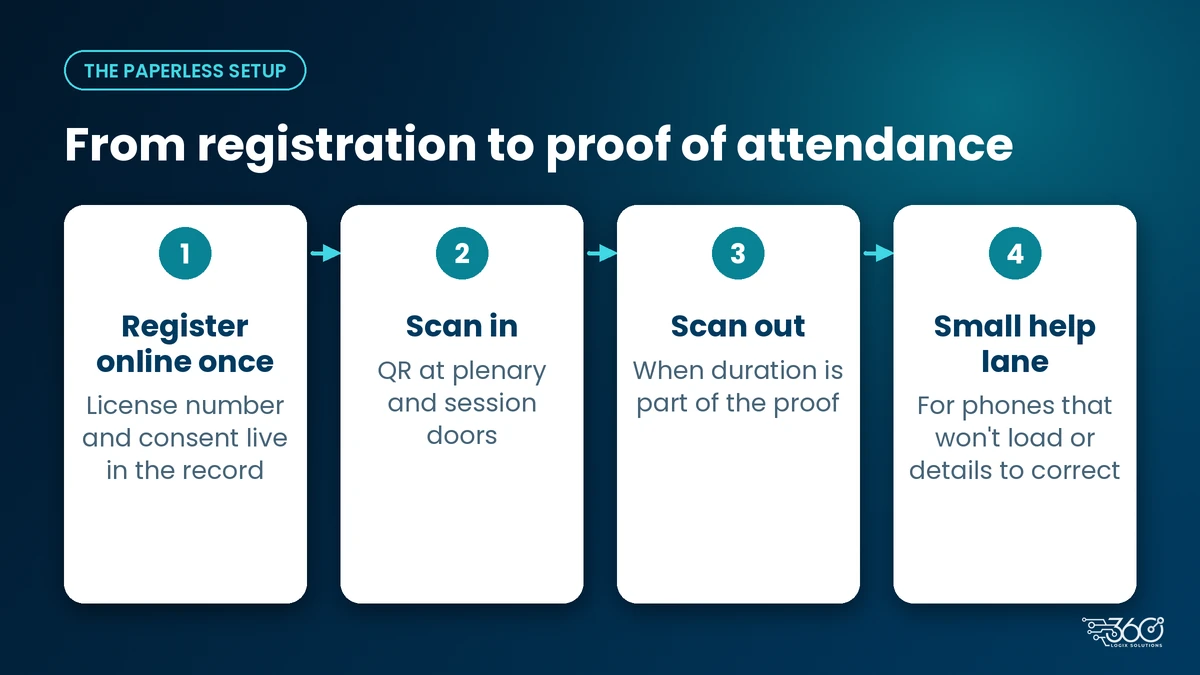
A practical paperless flow looks like this:
- Register online once. Membership status, license number and consent live in the registration record.
- Scan in at plenary and session doors. QR at the door marks attendance against that record.
- Scan out when your program requires it. Time-out matters when duration is part of the proof.
- Keep a small help lane. For people whose phone won't load, or whose details need a correction.
Kiosks at session doors can take volume off volunteer staff. The 55" Stand Kiosk is ₱10,000 per unit per day, VAT inclusive (see kiosk rentals).
Issuing CPD attendance certificates from scan data
Once scans sit on the registration record, a CPD attendance certificate can be generated from who actually attended, not from a stack of sheets. Send certificates soon after the event while questions are fresh. Use real-time attendance reports during the program when your team needs a live view of who is in which room.
Never promise CPD units in marketing copy. Units and accreditation sit with the provider and PRC rules. Your job on the tech side is accurate attendance proof and a certificate that matches it.
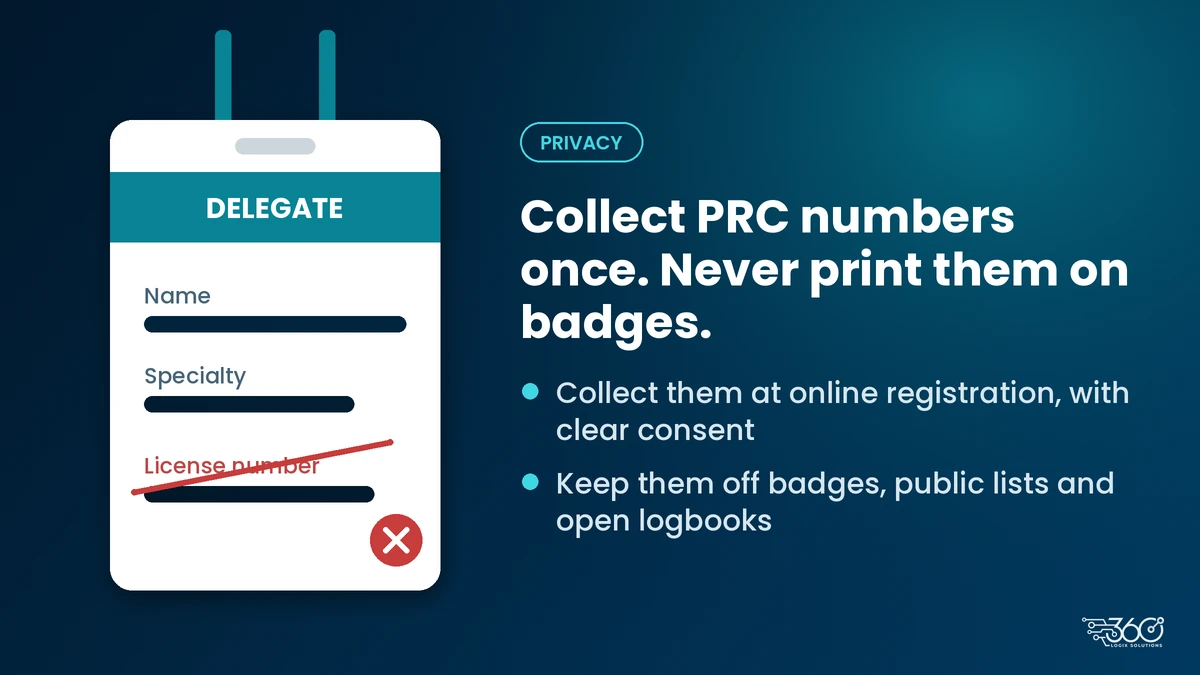
Privacy: collect PRC numbers once, never print them on badges
License numbers are sensitive in a queue. Collect them once at online registration with clear consent, store them in the system of record, and keep them off badges, public lists and open logbooks. NPC Circular 2023-04 expects consent that is specific and recorded. This is good practice under the Data Privacy Act, not legal advice for your association.
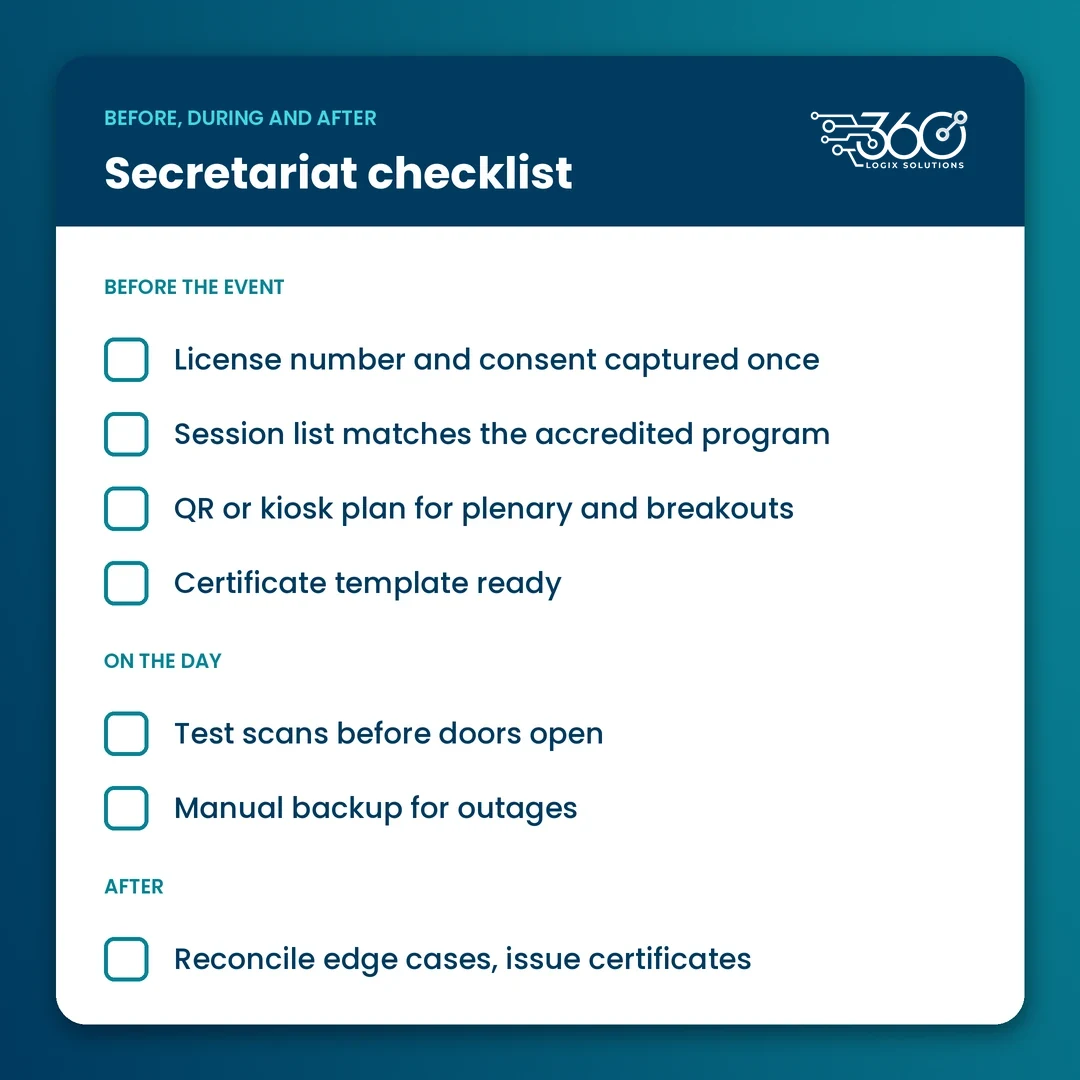
Secretariat checklist
Before the event:
- Registration form captures license number and consent once
- Session list matches the accredited program
- QR or kiosk plan for plenary and breakouts
- Help lane staffed for exceptions
- Certificate template ready to pull from attendance data
- Privacy review on what appears on badges and signage
On the day:
- Test scans before doors open
- Confirm session codes on each door screen or sign
- Keep a manual backup for outages
After:
- Export attendance and reconcile edge cases
- Issue certificates
- Store records per your retention policy
Where this fits in your convention week
Attendance tracking fails most often when it's bolted on after the program is locked. Build it into the week:
- When registration opens: license number and consent fields are live, not added later
- When the program is final: session list in the check-in tool matches the accredited agenda
- Night before: door scans tested on the real network
- Morning of: help lane briefed on what a failed scan looks like
- Within days after: certificates out, edge cases reconciled, export archived
If your secretariat is already underwater, prioritize session doors for breakouts where proof matters most, and keep plenary simple. Expand from there next year. Don't invent a perfect system on the first try and then skip the help lane.
Also keep marketing language honest. You can say you issue attendance certificates from verified scans. You cannot promise that any scan equals a PRC unit. Units sit with the provider rules and the delegate's CPDAS record.
FAQ
How do I track my CPD units as a delegate?
Use PRC's CPDAS for your own unit record. Event organizers can give you attendance proof and certificates; they don't replace your PRC account.
Can a QR scan replace a signature?
For many programs, a verified scan tied to a registration identity is cleaner than a door sheet. Confirm what your CPD provider and PRC process accept for that activity. Don't assume one method fits every board.
When must providers upload attendance?
Upload and reporting rules sit with PRC issuances and your provider status. Check the current CPDAS provider guidance before you set internal deadlines. We don't invent cut-off dates here.
Do you need digital tracking for every medical event?
No. Small programs with simple proof needs may still use careful paper. Mid-to-large conventions with many sessions benefit most from scan-based records.
Related: if some sessions are also streamed for remote delegates, see our guide to event live streaming setup.
Planning a CPD-ready check-in?
We've supported association and medical events for 15+ years, and attendance proof is one of the first operational questions secretariats raise once PRC rules shift. Talk to us about CPD-ready check-in and bring your session count, expected headcount and certificate timeline. We'll map a setup that matches your program, without promising units we don't control.
Related Articles
QR Code Check-In vs Manual Registration: Time, Cost and Attendee Experience
QR code check-in vs manual registration: compare desk time, cost, attendee experience and data privacy, and see the hybrid setup most events need.
5 Event Sponsorship Activation Ideas Using LED Posters at Conferences
Event sponsorship activation ideas for conferences: five LED Poster spots, from registration loops to session doors, plus a sponsor rotation package to sell.

How Much Does Event Tech Cost to Rent? Prices and Honest Answers
Event tech rental cost in Metro Manila: VAT-inclusive per-day rates for LED Posters, TV displays and kiosks, and how to get a clear quote.